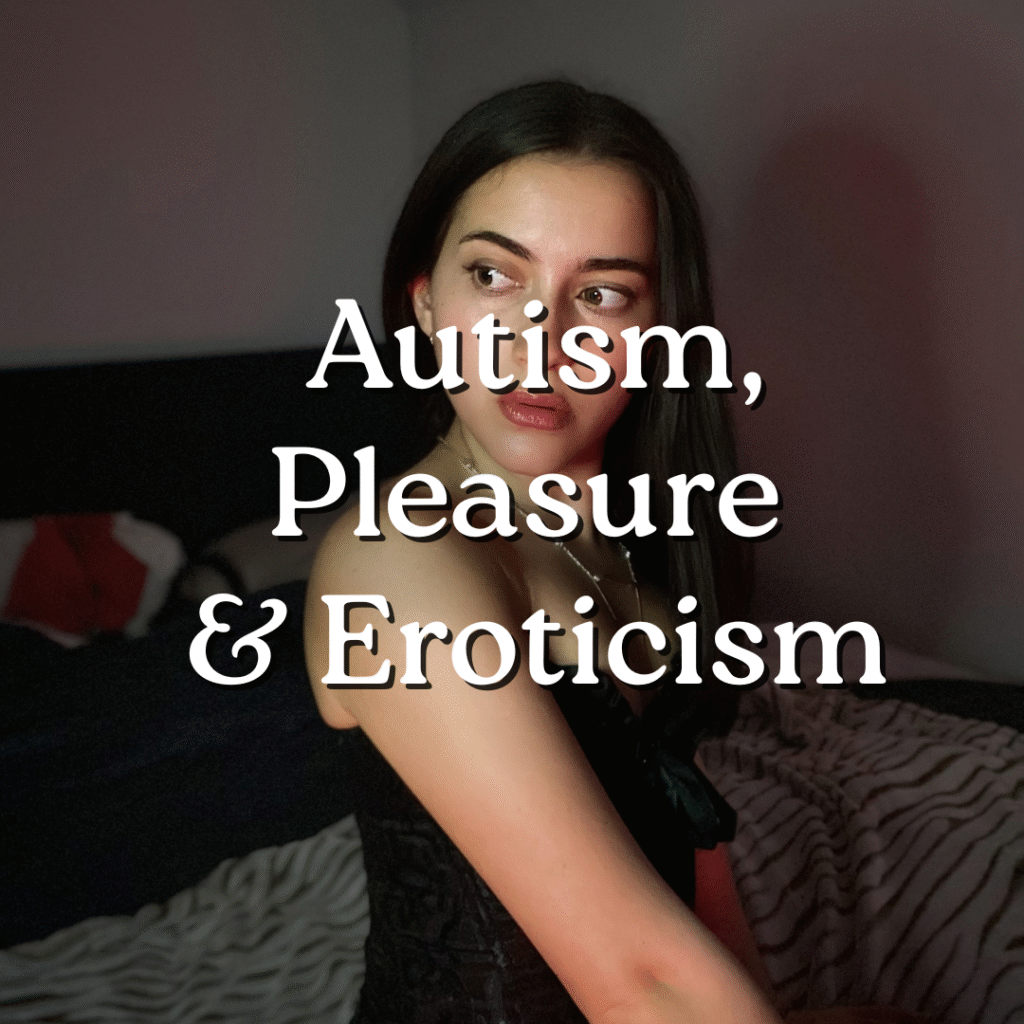
I attended a talk held by Alyshah Monroe, who held a space where neurodivergent women could share their experiences on pleasure, eroticism, and what it means to inhabit a neurodivergent body.
I felt hopeful and excited seeing women openly wanting to converse about these topics, ones so often deeply rooted in shame. Shame that neurodivergent people, especially women, hold so deeply in their bodies.
I believe the suppression of our magnetic, innate eroticism has caused more disease than sugar ever has.
This article speaks only from my experience as an autistic/ADHD woman, alongside reflections from other neurodivergent women who took part. I cannot speak for the male experience beyond what I have witnessed and experienced.
Sexual shame is no stranger to the human experience. Yet within neurodivergence, it often runs deeper. I have noticed how many within the community seem to alchemise that shame into kink, consciously or subconsciously, or into a powerful magnetism in their lives, self-expression, and energy. That paradox fascinates me.
Before diving further into neurodivergence, shame, and kink, lets understand the core ideology of this discussion…
What is eroticism, and how does it differ for neurodivergent people?
Eroticism is commonly defined as the quality of being sexually charged, cstimulating, or suggestive, often expressed through art, literature, or behaviour to provoke desire.
That is what appears when you search eroticism online.
My own interpretation feels broader. Eroticism, to me, is a lust for life and how one embodies it. A capacity to provoke aliveness in others that can feel sexually charged, or sometimes simply charged with expression. Sexual energy feels like the purest form of aliveness itself.
I have noticed a polarity among neurodivergent women. Some seem deeply tapped into their natural eroticism, something that appears to ooze from them effortlessly. Others carry layers-upon-layers of shame, shells that cut them off from themselves, leaving them exhausted and self-evasive.
Liberating your eroticism as a woman, and especially as a neurodivergent woman, feels to me like cleaning an old car. Once cleared, life can pour through you again.
Some of my most erotic experiences as an autistic woman are simple. The sun on my face as I tilt my head to feel warmth on my neck. The movement of my spine when a surge of energy moves through me and I instinctively need to move, what we might call a stim-like motion in the neurodivergent community.
These are moments of innate eroticism that exist quietly, often unobserved.
I believe eroticism can feel different for neurodivergent people because many of us lack the early social conditioning that tells us we should feel ashamed of it. Many neurodivergent women I spoke with described curiosity around pleasure from a very young age.
I often think of the scene in Amélie where she places her hand into a bag of lentils. The sheer pleasure of sensation, colour, and sound felt so vivid that it sent pleasure up my neck and turned me on to life itself.
Shame, in contrast, was learned.
Even then, I would argue the difference lies in awareness. Many neurodivergent women recognise shame as a fallible social construct. This may be why so many neurodivergent women find their way into sex work or feel at home within BDSM spaces, environments where erotic expression canexist more freely. Where humanity, oddly, makes more sense. Where the absurd feels familiar.
Interestingly, there was a shared consensus that sexuality for us, as a neurodivergent group, often centres more around sexuality as a philosophy than the act itself. The mental stimulation, expression, and artistry mattered far more than physical action alone. And who embodies that more than the kink community?
Pleasure, kink, and what is often misunderstood
I mentioned kink earlier, and I want to return to it now. I have noticed that many neurodivergent souls gravitate towards kink early in life as a way to explore and process the societal shame placed on us from such a young age.
One woman in the group spoke about reclaiming her power through the BDSM community after sex had felt extremely performative throughout much of her adolescence as a neurodivergent girl. We were taught to ignore our own bodily experiences for the pleasure of others. Reclaiming our pleasure and eroticism is profoundly powerful.
I had a similar experience during university when I began attending shibari workshops (think ropes). I am highly empathetic and, for many years, placed others’ needs above my own because I could feel their desire in my body. Not mine. It took me years to learn the difference.
Through rope work and dominatrix philosophy, I began to reclaim power I did not even realise I had given away. This kind of ‘sexual-subconscious-shadow- work’ is relevant to all humans, but I believe neurodivergent people often explore it earlier due to a combination of compounded shame that needs expression and our relative disregard for social norms.
Looking back, I can see that even in my teenage years I was exploring BDSM without understanding what it was. I now recognise that tying my partners up gave me physical space, ensuring my skin was not touched without consent, something especially important given my heightened sensory sensitivity as an autistic woman. It also made me feel safe and in control.
Kink and fetish can act as gateways to the subconscious. What you fantasise about can reveal what you desire, what you need, what you are working through. Much like dreaming, it can become another tool for liberation and unmasking, if you choose to engage with it consciously. I will write more about this another time.
I believe neurodivergent souls often understand that pleasure is so much more than sex; it is spiritual.
Questions to explore your own eroticism
Before the session, Alyshah asked us to reflect on three questions. They stayed with me, and I want to share them with you too.
If your sexual energy were a person, character, or mythological creature, what would it be, and why?
I chose a siren. Autistic intensity often draws people in.
Our magnetism comes from how deeply we make people feel seen. Our genuine curiosity. Our questions. Our ability to be fully present. Or perhaps it comes from our ability to make people feel emotionally and physically safe very quickly with out hyper-empathy.
This hyper-empathy with regards to shame can be deeply liberating in intimate spaces. Many people live their entire lives ashamed of their desires. To be seen and accepted by an autistic soul carries an acute siren energy.
Is there a message you were taught about relationships or sex that never truly worked for you?
Where to begin? All of it…
That pleasure comes solely from sex.
That intimacy is only physical.
That romantic relationships are more meaningful than platonic ones.
That physical pleasure must be sexual.
The list goes on.
Is there an autistic trait that benefits how you experience intimacy or pleasure?
We spoke about heightened sensitivity, how it can be both a blessing and a curse. It is something we are rarely taught how to navigate. Media focuses on maximising pleasure in a neurotypical body: more touch, more stimulation, more orgasms.
Many of us find too much touch painful rather than pleasurable. One woman suggested taking more breaks. I agree, and I would add that for me, mental stimulation is paramount and often takes precedence over physical stimulation.
Personally, my ability to feel and read energy benefits intimacy deeply. I can sense into my partner with ease, though perhaps that benefits their pleasure more than mine. Although, I feel intimacy through truly understanding another at their core so I suppose it benefits me too. For me, intellectual intimacy is what expands my capacity for pleasure.
Sex as an neurodivergent woman is a soul-level experience that exists, not just in the body, but physically, energetically, spiritually, and intellectually.
All in all…
All in all, I am grateful to have connected with such beautiful souls and to hear stories that had us laughing and nodding like Churchill dogs as we resonated deeply with one another’s niche experiences. Temperature regulation, shame, overwhelm, staying present, smells, tastes, communication, boundaries.
I want to end by saying that for me, there seems to be a clear distinction between sex, pleasure, and eroticism. As an autistic woman, eroticism is my soul expressed in human form. Pleasure is my ability to experience the sexuality of consciousness. Sex is a tool for all of the above, but it is not imperative for a pleasurable experience or erotic nature.
If this moved you at all, feel free to reach out. I will write more on this soon.
All my love,
Olivia Azura
X